
Workshop & summer school on “Modern trends in Combinatorial Optimization”

Combinatorial Optimization deals with discrete optimization problems that are defined on combinatorial structures such as graphs, networks, or discrete sets in geometric arrangements. Motivated by diverse practical problem setups, the topic has developed into a rich discipline at the intersection of mathematics and theoretical computer science. The area is deeply rooted in other fields such as […]
Postdoctoral workshop on “Variational Learning of Quantum Matter”

Mini-conference at the intersection between classical and quantum variational algorithms to study quantum many-body systems. 5 days of focused talks and discussions among the 50 participants on a large terrace with boards and a beautiful view of the Geneva Lake. We will cover fundamental problems such as embedding symmetries and representational power of variational states, (higher-order) optimization techniques and […]
Workshop on « Algorithms with predictions” also known as « Learning-augmented algorithms”

Algorithms with predictions, also known as learning-augmented algorithms, is an emerging field of research at the intersection of theoretical computer science and machine-learning. It looks to address the following question: How to use imperfect predictions in a robust way – retaining worst-case guarantees of classic algorithms – yet achieve optimal performance when the predictions are accurate? […]
Dynamics, Transfer Operators, and Spectra
The transfer operator is one of the basic tools of ergodic theory of smooth “chaotic” dynamics. Its discrete spectrum gives rise to the Ruelle-Pollicott resonances, which embody fundamental statistical properties of the dynamics. This semester-long program brings together three communities who share an interest in transfer operator methods (also in the presence of singularities): mathematicians […]
Dynamics with Structures
The theory of dynamical systems, which in barest terms is the study of maps from a set to itself, permeates mathematics and science. It is used in diverse contexts, from proving the existence of solutions of equations to the modelling of complex natural phenomena. In more recent years dynamical methods have proven to be remarkably […]
Multi-scale Mathematical Modelling and Coarse-grain Computational Chemistry
The M^3 + C^3 semester programme concerns molecular and materials modelling from atomistic to continuum scales. Our aim in the programme is to bring together theoreticians and practitioners, from all of applied mathematics, statistics, engineering, physics and computational chemistry, to work on the development of a systematic account of available coarse-grain and multi-scale techniques, with […]
Computational aspects of partition functions
Partition functions arise as fundamental quantities in physics, mathematics, statistics, computer science and many engineering disciplines. They are often notoriously hard to compute since they typically involve summations over an exponential number of terms. Different computational approaches have been developed in various mathematical disciplines to bound or estimate these important quantities. The aim of this […]
Descriptive set theory and Polish groups
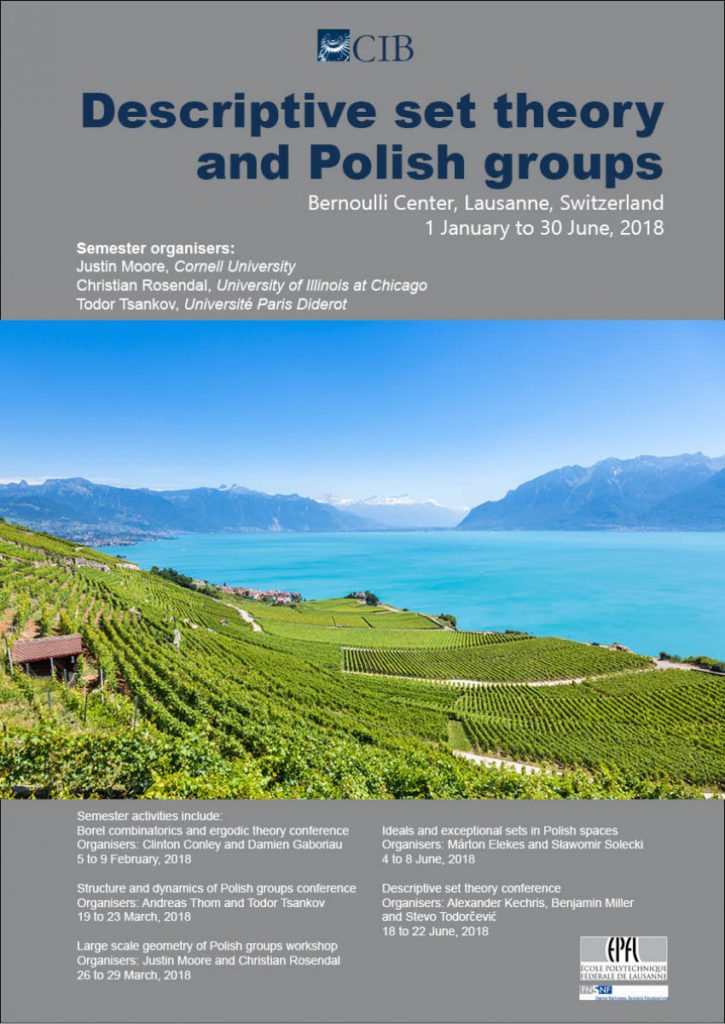
Descriptive set theory is classically defined as the study of definable (e.g. Borel, analytic) sets in Polish spaces — separable, completely metrizable spaces. It has long thrived in its connections with classical areas of mathematics such as harmonic and functional analysis and logic (set theory and computability theory in particular). Over the course of the […]
Euler Systems and Special Values of L-functions
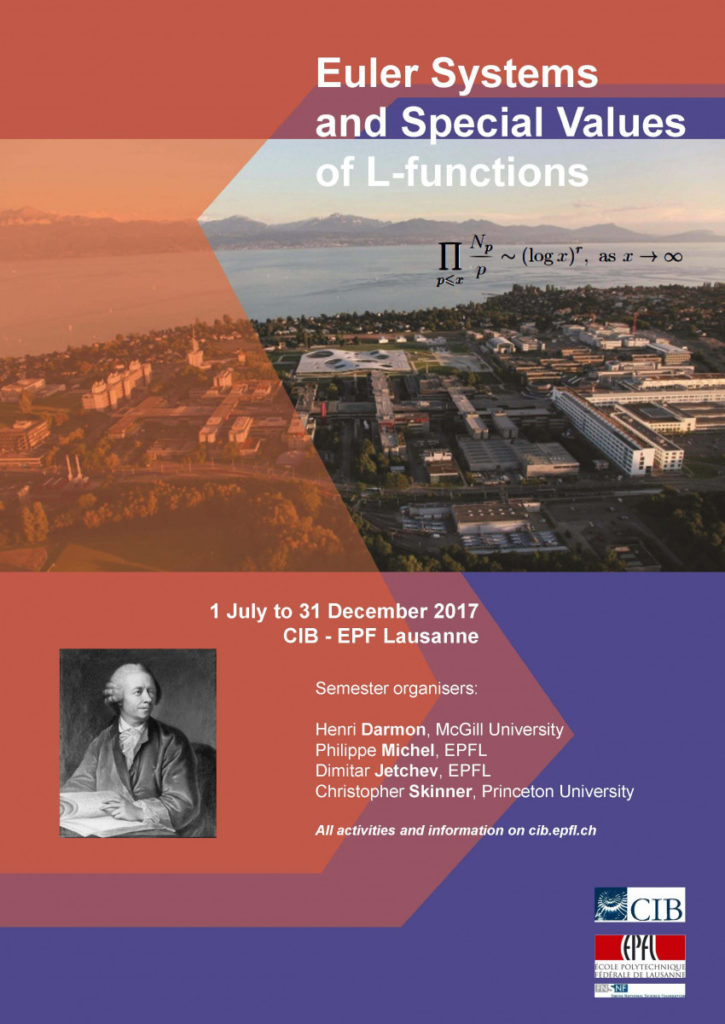
The goal of this semester-long program is to gather the leading experts in the area of Euler systems and the Birch and Swinnerton-Dyer conjecture in order to initiate a more systematic study of Euler systems on higher rank reductive groups and their applications to generalizations of the BSD conjecture (Bloch–Kato–Beilinson conjectures). At the same time, […]
Stochastic Dynamical Models in Mathematical Finance, Econometrics, and Actuarial Sciences
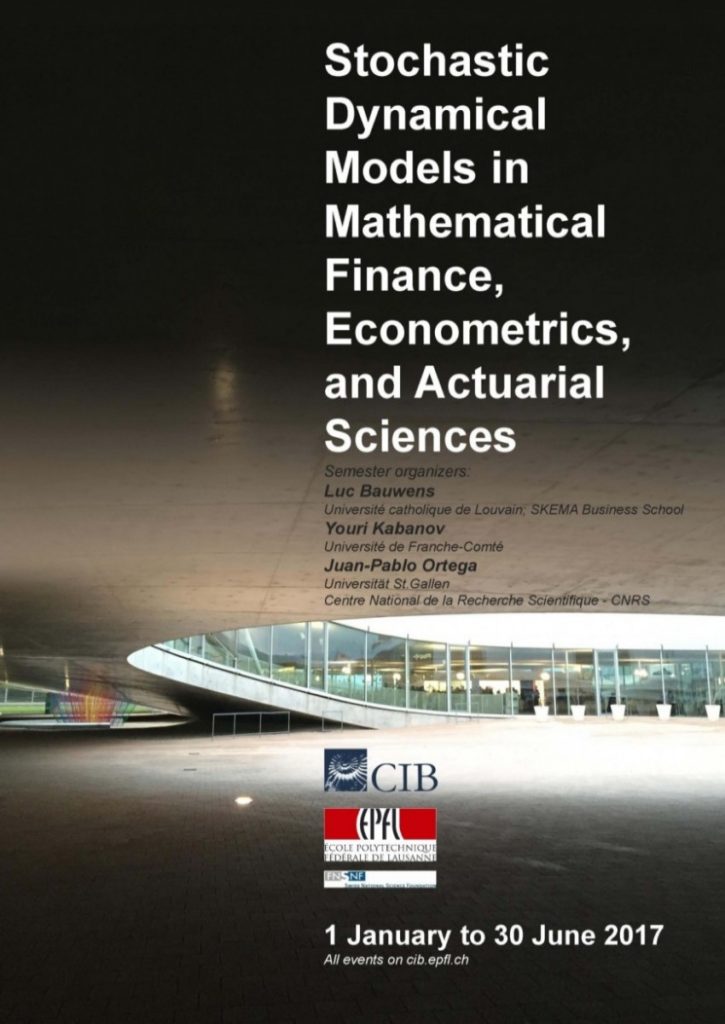
This program focuses on three important areas where stochastic dynamical models play a major role, namely, mathematical finance, econometrics, and actuarial sciences. Stochastic dynamical models are of major importance in mathematical finance where, for example, the quality of the non-arbitrage pricing and hedging instruments for derivative products that this theory produces depends strongly on the […]