WATCH REPLAY HERE
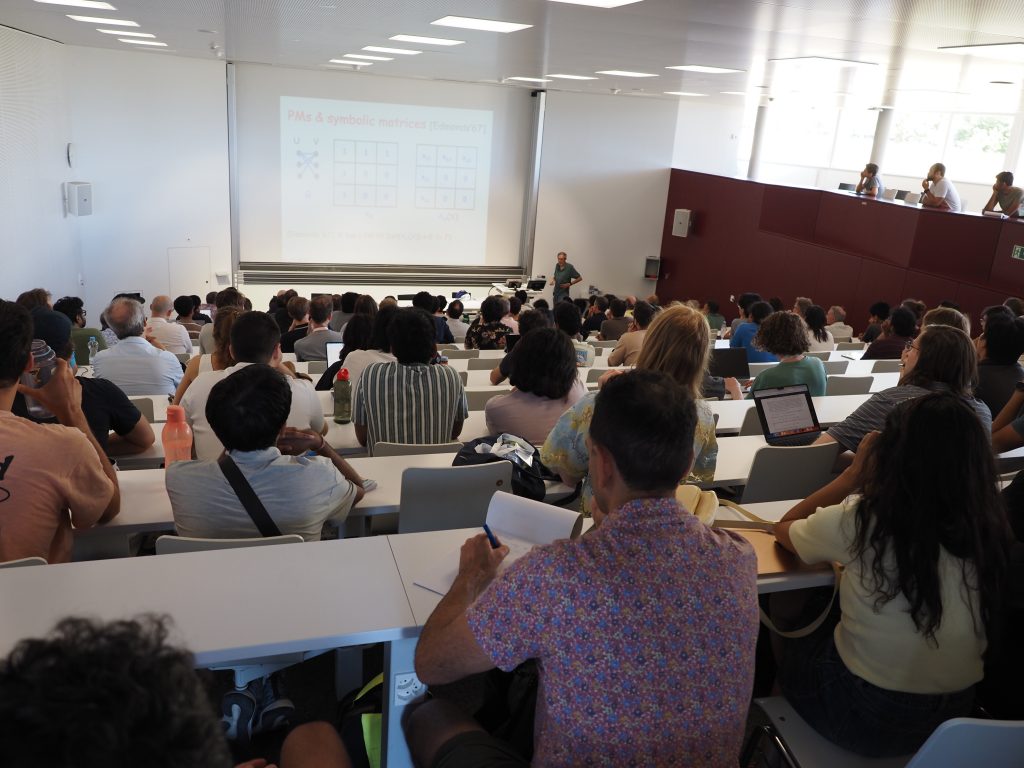
The lecture by Professor Avi Wigderson (Institute for Advanced Study, Princeton), held on Thursday, 2 July, was a great success. The event attracted a large audience, reflecting the strong interest in the topic and the exceptional reputation of the speaker. Participants greatly appreciated the opportunity to hear insights from a scientist of Professor Wigderson’s caliber, and the lecture sparked engaging discussions throughout the audience. We are delighted to have welcomed such a distinguished speaker and thank everyone who attended for contributing to the success of the event.
Title: Optimization, Complexity and Math (or, can we prove P!=NP by gradient descent?)
Abstract:
This talk aims to summarize a project I was involved in during the past decade, with the hope of explaining our most complete understanding so far, as well as challenges and open problems. The main messages of this project are summarized below; I plan to describe, through examples, many of the concepts they refer to, and the evolution of ideas leading to them. No special background is assumed.
We extend the most basic tools of convex optimization in Euclidean space to a far more general setting of Riemannian manifolds that arise from the symmetries of noncommutative groups. We develop first-order and second-order algorithms, and analyze their performance in general. Invariant theory, which studies such group actions, plays an essential role in this development. The focus on symmetries exposes old and reveals new relations between the application problems below.
These algorithms give exponential (or better) improvements in run-time for solving algorithmic many problems across CS, Math and Physics. In particular, these include problems in algebra (e.g. testing rational identities in non-commutative variables), in analysis (testing the feasibility and tightness of Brascamp-Lieb inequalities), in quantum information theory (to the quantum marginals problem), in algebraic geometry (to computing Kronecker coefficients), in computational complexity (to derandomizing new special cases of the PIT problem) and in optimization (to testing membership in large, implicitly described polytopes).
Based on joint works with Zeyuan Allen-Zhu, Peter Burgisser, Cole Franks, Ankit Garg, Leonid Gurvits, Pavel Hrubes, Yuanzhi Li, Visu Makam, Rafael Oliveira and Michael Walter.