External programs

External programs 2024

Random Geometry and Number Theory

This workshop is part of the Bernoulli  programme at EPFL, to be held from 22 June to 03 July 2026.

The two-week event will broadly focus on spectral geometry, hyperbolic surfaces, and number theory, with the primary goal of fostering connections between these areas. By bringing together young researchers and engaging them in ongoing discussions around these topics, we aim to encourage collaboration and stimulate progress across these fields.

The first week will feature mini-courses delivered by young participants, providing an opportunity for early-career researchers to share their expertise.

The second week will consist of research-level talks by experts, highlighting recent developments in the field.

Elliptic objects, von Neumann algebras, and Functorial Field Theory

This two-week programme will be held from 06 to 17 July 2026. The first week features a series of lecture courses primarily aimed at early-career researchers. The second week is a research conference.

A central theme of the meeting is Functorial Quantum Field Theories beyond TQFTs and the Segal-Stolz–Teichner programme.

The event will highlight recent developments in extended functorial field theories; analytic structures in quantum field theory, including higher categorical analogues of  von Neumann algebras and Hilbert spaces; categorified geometric structures, such as higher vector bundles and stringor bundles; and, supersymmetry and its role in generalized cohomology theories.

The workshop and conference hope to provide an opportunity to advance the interface between homotopy theory, operator algebras, and quantum field theory.

FOUVRY – 73

This programme will be held from 17 August to 11 September 2026.

By its very nature, analytic number theory involves a very broad array of methods and tools. It has been instrumental in developing a number of important areas of mathematics, such as representation theory, from the characters of finite abelian groups, used by Dirichlet to study primes in arithmetic progressions, to the representation theory of reductive Lie groups, which is an essential component of the Langlands program. In recent years, important breakthroughs have been achieved using tools borrowed, for instance, from ergodic theory and homogeneous dynamics, from additive combinatorics, or from very fine aspects of probability theory (such as the so-called Gaussian Multiplicative Chaos).

It is because of the truly kaleidoscopic aspect of analytic number theory that young researchers benefit immensely from broad instructional programs where they can get first exposure to some of the new techniques which may be of critical importance in their own research.

The four-week programme at the Bernoulli Center aims at giving exactly this type of insight to PhD students and postdocs.


The CIMPA and the Bernoulli Center collaborate to fund the participation of young researchers, including doctoral students and those who have completed their doctorate within the last 5 years or are under the age of 36. This opportunity is aimed at individuals based in developing countries, as defined by the IMU-CDC. You can find more information and how to apply on this page.
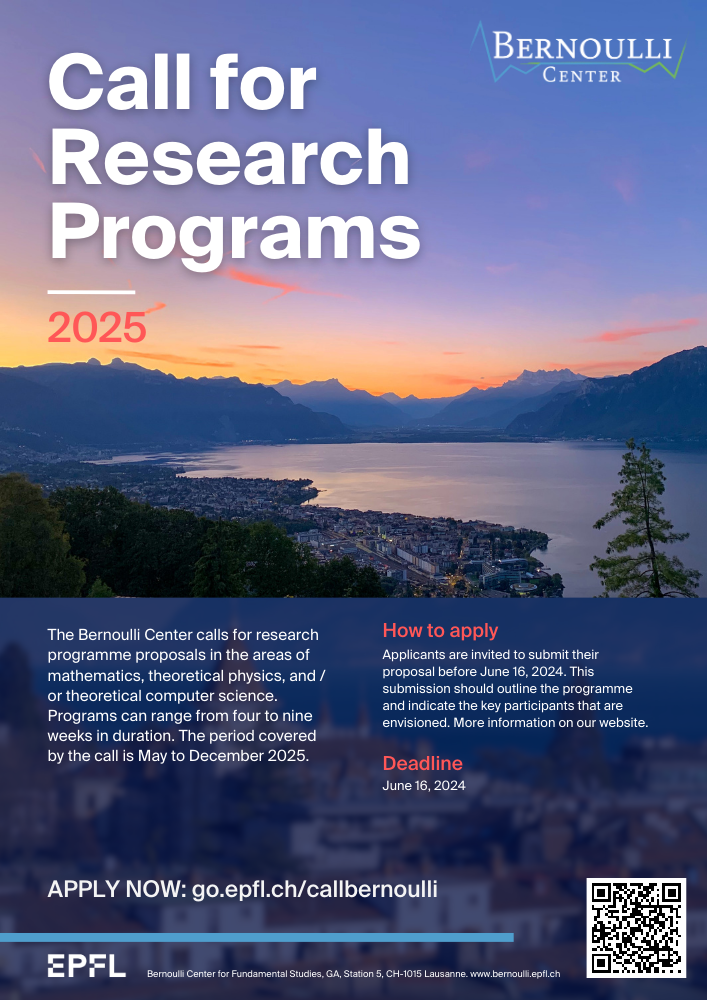
 

Call for Research Programs 2025


The Bernoulli Center calls for research program proposals in the areas of mathematics, theoretical physics, and/or theoretical computer science. The deadline for proposal submissions is June 16, 2024 and the period covered by the call is May to December 2025. 

Proposals should include the following information:

  1. Program name
  2. Names, short CV’s, and email addresses of organisers
  3. Duration of the program and preferred dates
    Programs can range from four to nine weeks in duration. Please do indicate your preferences regarding dates, but try to be as flexible as possible.
  4. Scientific program
    Give a detailed description of the proposed program, including an overview of the topic area, recent achievements, future research directions, timeliness of the proposal, relation to programmes held at other research institutes, etc. This should include a summary that is accessible to research mathematicians working in a completely unrelated field, as well as a more detailed (up to three pages) part accessible to experts working in adjacent areas.
  5. Program structure
    This should include a description of the planned activities like workshops (including number of participants and durations), weekly seminars, public lectures, minicourses, etc. We encourage you to contact colleagues working in your area at EPFL to explore the possibility of offering PhD level courses that can be counted for credit by EPFL students.
  6. Potential participants
    The list of potential participants should be about 15-25% longer than the proposed size of the program to account for cancellations. Ideally, potential long-term participants will already have been contacted for a tentative agreement. The center will provide shared office space for up to 10 researchers, with additional modular space available for discussions or shared desk space, and it can accommodate workshops / seminars with about 50 participants.
  7. Budget in CHF
    Please do include a detailed budget with your proposal. A guideline budget ranges from around CHF 80k for a four weeks programme to around CHF 140k for a nine weeks programme. Participants will be encouraged to use their own travel funds when possible.
Note: The SwissMap research station at Les Diablerets is located nearby and, depending on availabilities, can also be used to organise a workshop / retreat during a Bernoulli research programme.
 

Please send your proposal to Martin Hairer (martin.hairer@epfl.ch ) for consideration.

The long-term research programs will start once the center expansions / renovations are completed.